The UK vaping market is undergoing its most comprehensive legislative restructuring since the implementation of the Tobacco and Related Products Regulations (TRPR). Following the passage of the landmark Tobacco and Vapes Act 2026, the sector faces tight restrictions spanning point-of-sale displays, device architecture, advertising, and a new excise duty framework administered by HM Revenue & Customs (HMRC).
Whether you are a retailer adjusting supply chains, a brand manager revising product portfolios, or a consumer tracking market trends, here is a detailed breakdown of the policy updates and economic shifts redefining the UK vape industry.
1. The Tobacco & Vapes Act: Packaging and Display Overhaul
The enactment of the Tobacco and Vapes Act grants the Department of Health and Social Care (DHSC) broad statutory powers to regulate non-tobacco nicotine products. Designed to curb youth appeal, the new framework introduces standardized branding mandates and retail visibility controls.
+----------------------------------------------------------------------------------+
|                    SUMMARY OF PROPOSED STANDARDIZED CONTROLS                     |
+------------------------------------+---------------------------------------------+
| Feature                            | Regulatory Measure                          |
+------------------------------------+---------------------------------------------+
| Outer Packaging                    | Standardized neutral tones (plain white/gray)|
| Typography                         | Uniform font sizing (e.g., max 14pt Helvetica) |
| Flavour Names                      | Simplification to basic descriptors          |
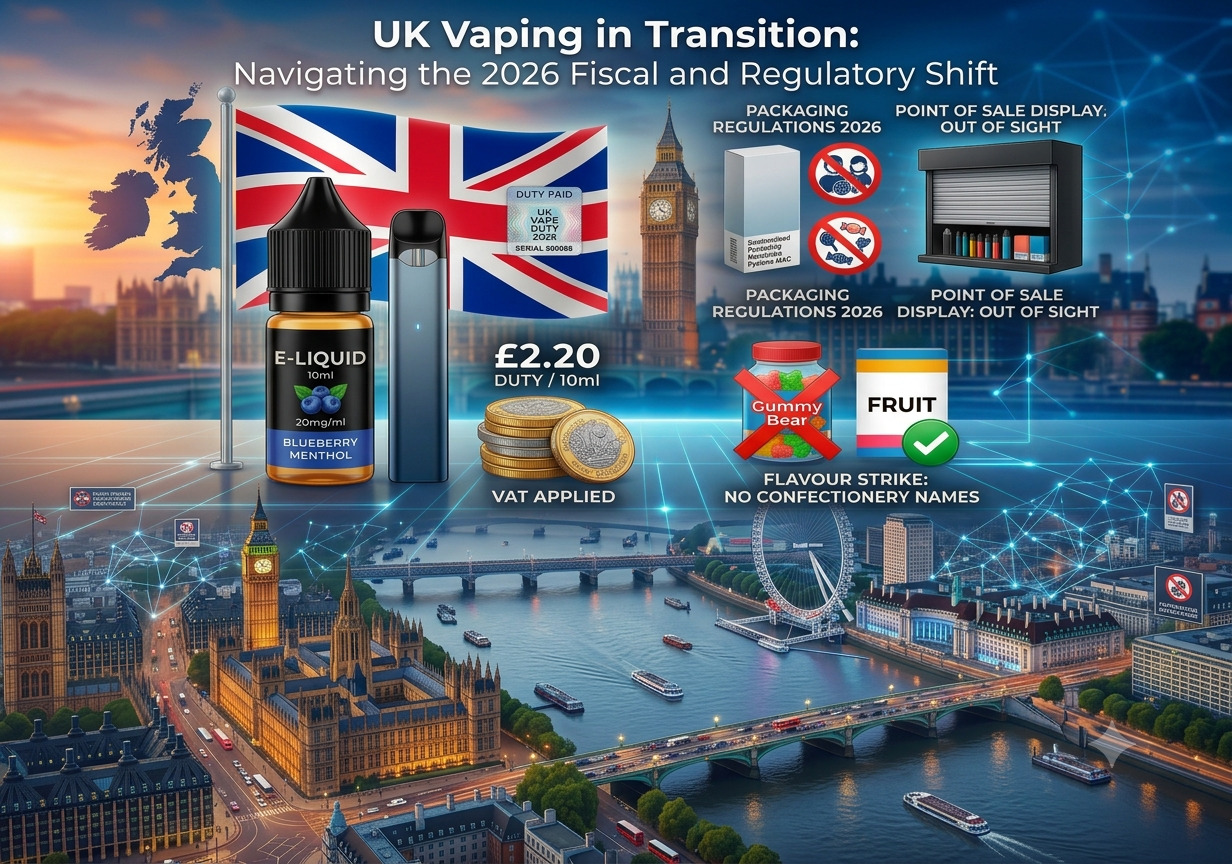
| In-Store Display                   | Under-counter / behind opaque gantries      |
+------------------------------------+---------------------------------------------+
Standardized Packaging & Flavour Descriptors
- Visual Restrictions: The government’s consultation proposals outline strict limits on physical e-liquid and hardware packaging. Bright colors, cartoon graphics, metallic foiling, and prominent logos are slated for replacement with plain, standardized white or gray casing.
- Descriptor Limits: Flavour designations face tight scrutiny. Descriptors reminiscent of confectionery or soft drinks (e.g., “Gummy Bear”, “Blue Razz Lemonade”) are being phased out in favor of basic, single-word profiles like “Blueberry” or “Menthol”.
Point-of-Sale Visibility
Following the model used for combustible tobacco, retail outlets will be required to move all vaping hardware and e-liquids behind opaque gantries or under-counter storage. Interactive display units and branded countertop stands will be prohibited in brick-and-mortar stores.
2. Post-Disposable Enforcement & Trading Standards
Following the ban on single-use (disposable) vapes, local Trading Standards officers and Border Force authorities have intensified retail and import inspections.
  CONSUMER PREFERENCE SHIFT POST-DISPOSABLE BAN

  [ Disposables ]  ──>  [ Reusable Pod Kits ]  ──>  [ Big Puff Systems ]
  (Banned)              (USB-C / Refillable)         (2ml Pod + 10ml Refill)
Seizure Rates and Market Compliance
Freedom of Information (FOI) data reveals that local authorities seized over 1.3 million illegal or non-compliant vape units within the first 12 months following the disposable ban. To remain legally compliant, devices must now be fully:
- Rechargeable (via standardized USB-C interfaces)
- Refillable (utilizing open pods or modular tanks)
- Equipped with replaceable components (coils or pod units)
Despite enforcement, trade bodies such as the UK Vaping Industry Association (UKVIA) highlight an ongoing challenge: black-market trade in non-compliant “oversized” devices (e.g., 10,000+ puff single-use units containing excess liquid capacity) remains high, prompting calls for strict retail licensing.
3. The 2026 Vaping Products Duty (VPD)
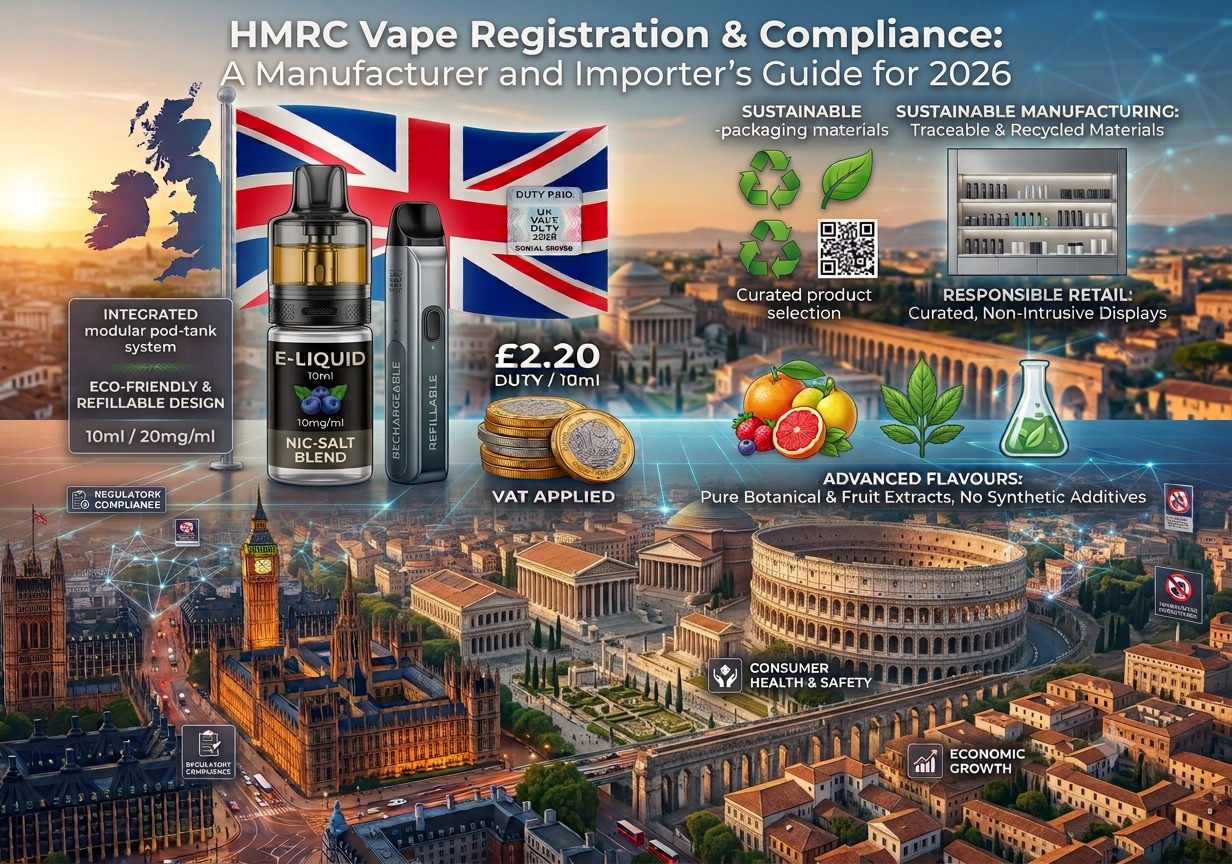
The most significant financial update is HMRC’s introduction of the Vaping Products Duty (VPD), coming into force on October 1, 2026. The duty establishes an excise tax framework across all liquid formats, regardless of nicotine strength.
Key Rule: The tax is calculated on fluid volume, not nicotine concentration. Nicotine-free (0mg) e-liquids and shortfills are taxed at the exact same rate as high-strength nicotine salts.
+----------------------------------------------------------------------------------+
|                           VAPING PRODUCTS DUTY METRICS                           |
+------------------------------------+---------------------------------------------+
| Effective Implementation Date      | October 1, 2026                             |
| Flat Duty Rate                     | £2.20 per 10ml of e-liquid                  |
| Standard VAT Application           | 20% applied on top of Duty + Base Price     |
| Net Tax Addition per 10ml          | £2.64 total                                 |
+------------------------------------+---------------------------------------------+
Price Impact Analysis Across Product Categories
Because the duty is tied strictly to volume, different product formats will see vastly different percentage price increases:
| Format | Avg. Pre-Tax RRP | Duty + VAT Addition | Projected Retail Price | Est. Price Increase |
| Pre-filled Pods (2 × 2ml) | £6.00 | +£1.06 | £7.06 | ~18% |
| 10ml Nic Salt / Freebase | £3.99 | +£2.64 | £6.63 | ~66% |
| 50ml Shortfill (+ 1 Nic Shot) | £13.00 | +£15.84 | £28.84 | ~122% |
| 100ml Shortfill (+ 2 Nic Shots) | £15.00 | +£31.68 | £46.68 | ~211% |
Compliance Mechanism: Physical Duty Stamps
HMRC is establishing a physical tracking scheme to verify tax compliance and prevent grey-market distribution:
- April 1, 2026: Registration opens for approved manufacturers and importers to apply for HMRC approval and order duty stamps.
- October 1, 2026: Duty becomes legally payable on all newly manufactured or imported stock released for retail.
- April 1, 2027: The end of the transitional sell-through window. After this date, carrying or selling unstamped vaping stock in the UK becomes illegal.
4. Market Evolution & Alternative Categories
The Rise of “Big Puff” Reusables
In response to changing consumer demands, hardware manufacturers have shifted focus to compliant “Big Puff” systems. These setups combine a rechargeable battery base with a TPD-compliant 2ml primary pod fed automatically by a dedicated 10ml refill reservoir. This architecture maintains compliance while offering extended usage cycles.
Nicotine Pouches
Oral, tobacco-free nicotine pouches have seen accelerated market adoption as an alternative harm-reduction option. While currently outside the scope of the liquid-based Vaping Products Duty, the Tobacco and Vapes Act introduces powers to regulate their age-of-sale, flavor descriptors, and marketing channels starting in 2027.
Looking Ahead
As the UK balances youth protection with adult smoking cessation, the market is adjusting rapidly. For manufacturers, distributors, and retailers, early supply chain adaptation—particularly regarding HMRC registration and packaging compliance—will be critical to navigating the transition smoothly.